The Skatepark
THE SKATEPARK
According to Helen Woolley in the article “Excluded from streets and spaces?” (2003), skateboarders are unwelcome and banned in the centres of many northern towns:
“The exclusion of skateboarders from their natural terrain in urban cores has also begun to be implemented in towns and cities in the UK, particularly in the north of England. Manchester City Council banned skateboarding from various public spaces, including outside the Town Hall, in 1997 (Press, 1997). This had a major effect upon the way in which skaters inhabit spaces in the city.”
Ms Woolley goes on to say that this is a form social exclusion:
“Open spaces in urban areas, which allow for public use, whoever owns them, are some of the most democratic spaces that exist (Worpole and Greenhalgh, 1996). They provide opportunities for a wide range of activities and benefits relating to many different areas of life: social, environmental, physical and mental health and economic (Dunnett, Swanwick and Woolley, 2002 and Woolley, 2003). Such benefits clearly enhance the quality of life of the increasing millions of people who live in urban areas. To realise the full potential of these benefits people need to be able to access and use them when and how they want. Not to be able to use such spaces in a way an individual would like to could be defined as social exclusion, following the argument of Burchardt, Le Grand and Piachaud’s (1999) that someone should be geographically resident, want to participate in an activity and be prevented from doing so through no fault of their own.”
Ms Woolley states that after skateboarders were banned from Hallam University Square in Sheffield, they moved to the city’s Tudor Square, until they were banned from there too. The article states that one of the reasons why squares in city centres are so popular with skateboarders is that they are accessible as meeting places for skateboarders from across the city.
Councillors in Leeds were particularly annoyed by skateboarders using Millennium Square and the steps in front of the Civic Hall, as the skateboarders were damaging the stonework. Initially, councillors tried to deal with the ‘problem’ by introducing a byelaw which banned skateboarding on Millennium Square. Ms Woolley states :
“Bradford and Leeds have also banned skateboarding from outside specific buildings or from particular urban spaces but one skateboarder commented: ‘they have tried to stop us skateboarding before but it made no difference then, and it will make no difference now. What are they going to do? Lock us all up?’ (Wilson, 1997)”
When the byelaw failed to deter skateboarders from using Millennium Square, in 2003 the council spent £250,000 building a skatepark on Woodhouse Moor which according to a BBC article published in May 2003, was intended to attract skateboarders away from Millennium Square. It’s unprecedented for so much money to be spent creating a new facility in a Leeds park.

And so a hard concrete environment which already existed in the city centre, has been recreated at huge expense in the green environment of Woodhouse Moor an environment which was originally intended to give local people a country estate experience. The area affected by the skatepark is far larger than the skatepark itself. It can be seen and heard across an entire corner of the park. Because Woodhouse Moor is difficult to access by public transport for people in other parts of Leeds (unlike the city centre) skateboarders are often dropped off there by their parents, who call again several hours later to pick their children up, as a letter published in the YEP on the 19th April 2003 entitled “Skatepark money well-spent” makes clear:

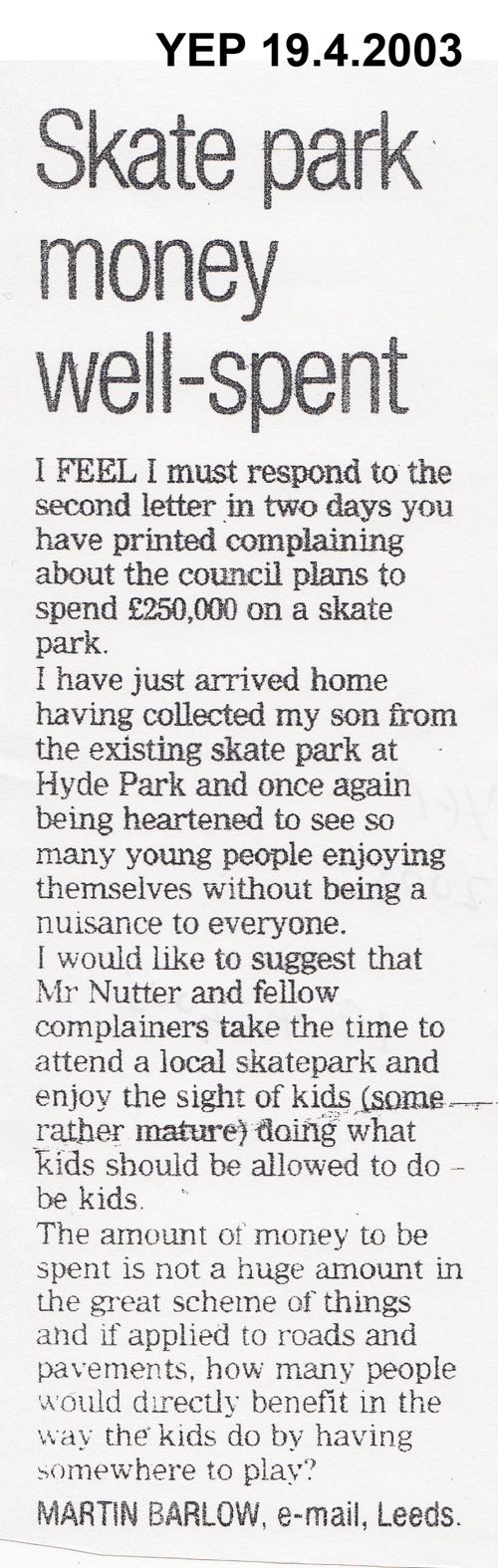
” I FEEL I must respond to the second letter in two days you have printed complaining about the council plans to spend £250,000 on a skatepark.
I have just arrived home having collected my son from the existing skatepark at Hyde Park and once again being heartened to see so many young people enjoying themselves without being a nuisance to everyone.
I would like to suggest that Mr Nutter and fellow complainers take the time to attend a local skatepark and enjoy the sight of kids (some rather mature) doing what kids should be allowed to do – be kids.
The amount of money to be spent is not a huge amount in the great scheme of things and if applied to roads and pavements, how many people would directly benefit in the way the kids do by having somewhere to play?”
Here’s the story of how the skatepark came to be built.
THE PROBLEM – SKATEBOARDERS USING MILLENNIUM SQUARE
In an article published in the YEP on the 21st November 2002 entitled, “Ban the boards,” journalist David Marsh described the ‘problem’ caused by skateboarders using Millennium Square:
“TOUGH action is needed to stop skateboarders damaging one of the finest buildings in Leeds, claims a senior councillor.
The steps at the imposing Millennium Square entrance to Leeds Civic Hall have become a popular location for skateboarders to practise their stunts and tricks. Critics of the 12m square – a huge paved area in front of the Civic – warned the council it would become the biggest skateboard park in England.
The council introduced by-laws banning skateboarding and rollerblading in the square but they have had little effect.
Now Coun Gerry Harper (Lab, University), Labour’s chief whip, is demanding action to tackle the problem.
He said: “The steps of this grade II listed building are beng chipped and damaged by the skateboarders. I walked past there one Saturday recently and there must have been 15 of them skateboarding along the steps.
“I did ring Millgarth Police Station and officers on patrol did come along to move these people on. The skateboarders are not young children. Some of them look like they are aged in their early 20s and they should know better.
“Simply moving them on isn’t really working. We have these laws and we should use them. If some of those breaching the by-laws were caught and fined it could prove a deterrent.
“It would show that we take this problem seriously and we mean business.”
Coun Harper suggested the council could put some of the moveable trees in Millennium Square in front of the steps to restrict access to the skateboarders.
Coun Elizabeth Minkin, executive councillor for development, said: “We are doing all we can to get across the message that skateboarding is not permitted in Millennium Square. The stonework of the Civic Hall is being damaged and this is not acceptable.”
THE ANSWER – A NEW SKATEPARK ON WOODHOUSE MOOR
In an article published in the YEP on the 8th April 2003 entitled “Kids on board,” journalist David Marsh explained that a new skatepark was planned for Woodhouse Moor which it was hoped would solve the problem of skateboarders using the Civic Hall steps:
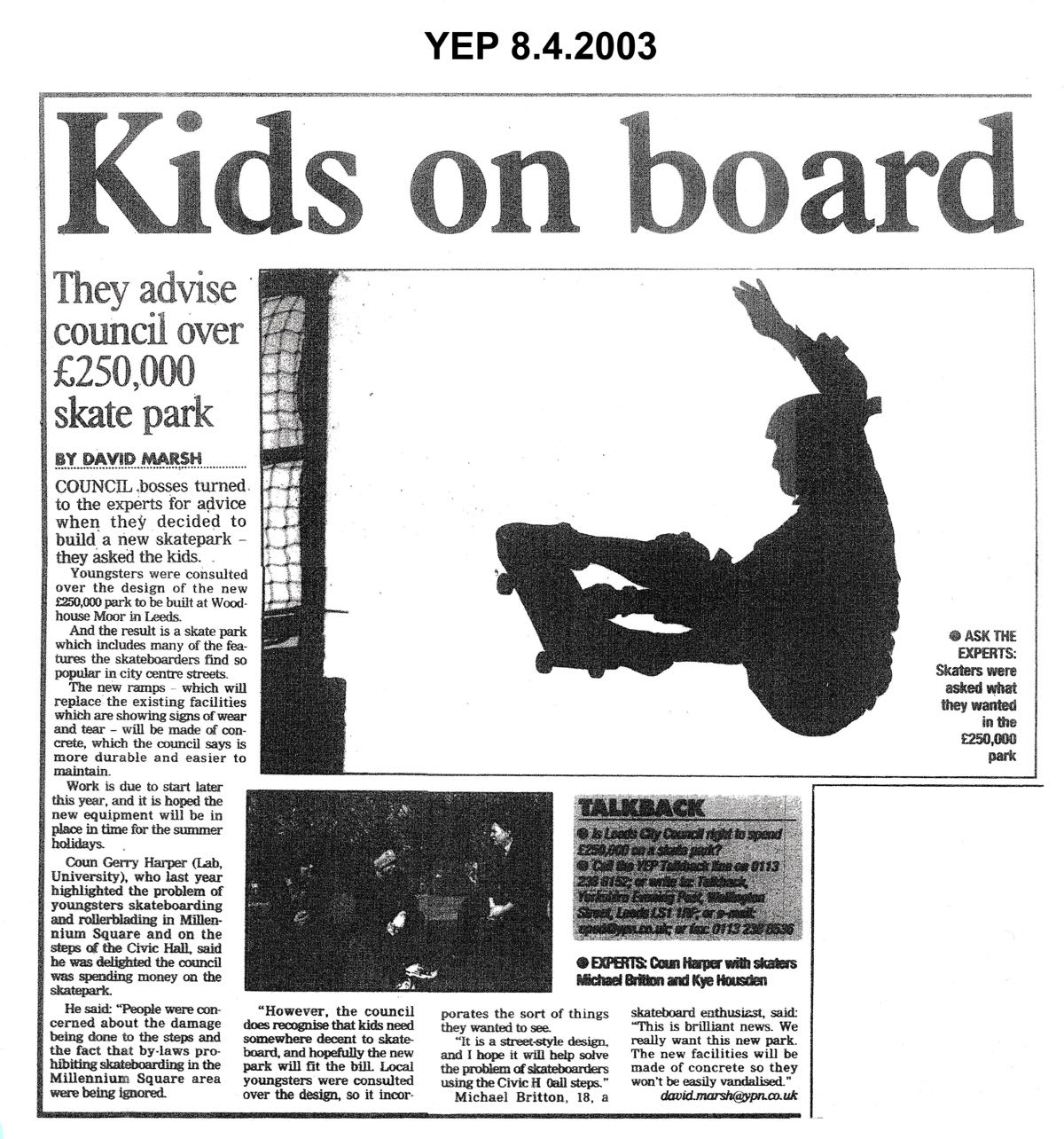
Work is due to start later this year, and it is hoped the new equipment will be in place in time for the summer holidays.
Corn Gerry Harper (Lab, University), who last year highlighted the problem of youngsters skateboarding and rollerblading in Millennium Square and on the steps of the Civic Hall, said he was delighted the council was spending money on the skatepark.
He said: “People were concerned about the damage being done to the steps and the fact that by-laws prohibiting skateboarding in the Millennium Square area were being ignored.
“It is a street-style design, and I hope it will solve the problem of skateboarders using the Civic Hall steps.”
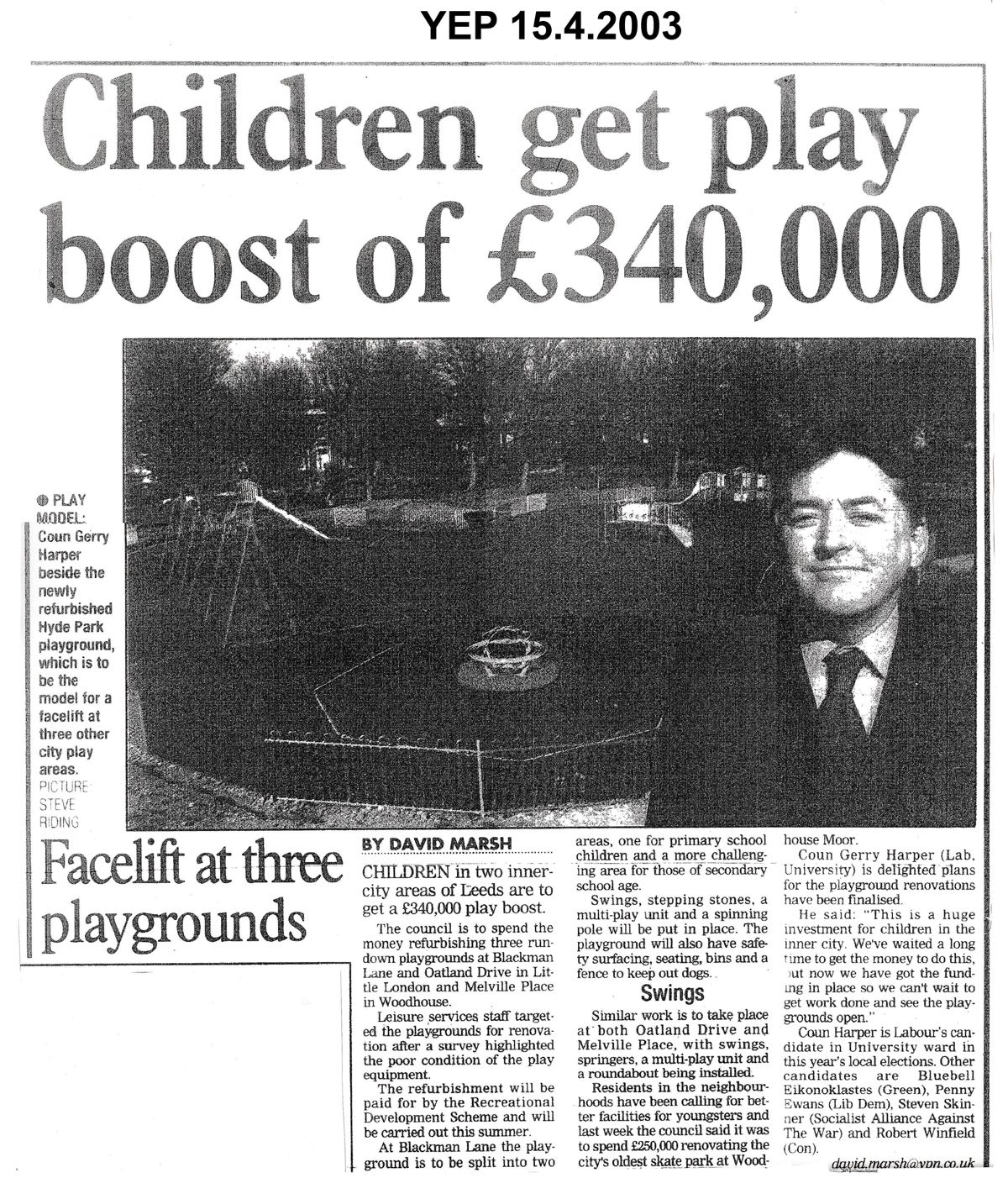
An article published in the YEP on the 15th April 2003 entitled, “Children get play boost of £340,000” explained that the money for the new skatepark would come from the “Recreational Development Scheme.”
The council’s Decision Notice shows that the council applied to itself to build the skatepark on the 19th May 2003 and approved its application on the 3rd July 2003.
THE BOWLERS’ AND OTHERS’ RESPONSE TO MONEY BEING SPENT ON THE SKATEPARK
In a letter published in the YEP on the 14th April 2003 entitled “Too much for the young,” Anthony Child wrote:
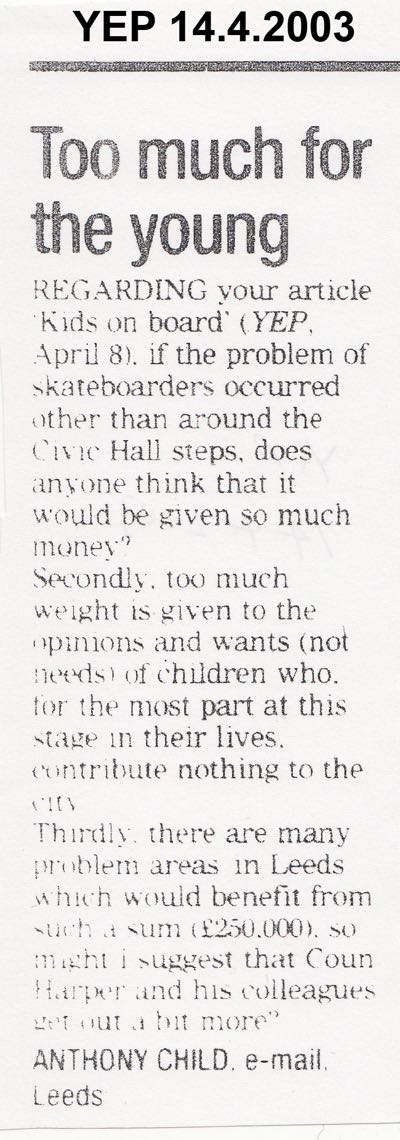
“REGARDING your article ‘Kids on board’ (YEP April 8), if the problem of skateboarders occurred other than around the Civic Hall steps, does anyone think that it would be given so much money?
Secondly, too much weight is given to the opinions and wants (not needs) of children who, for the most part at this stage of their lives, contribute nothing to the city.
Thirdly, there are many problem areas in Leeds which would benefit from such a sum (£250,000), so might I suggest that Coun Harper and his colleagues get out a bit more.”
The following three letters were published in the YEP on the 24th April 2003 under the title “Why must older people miss out?”
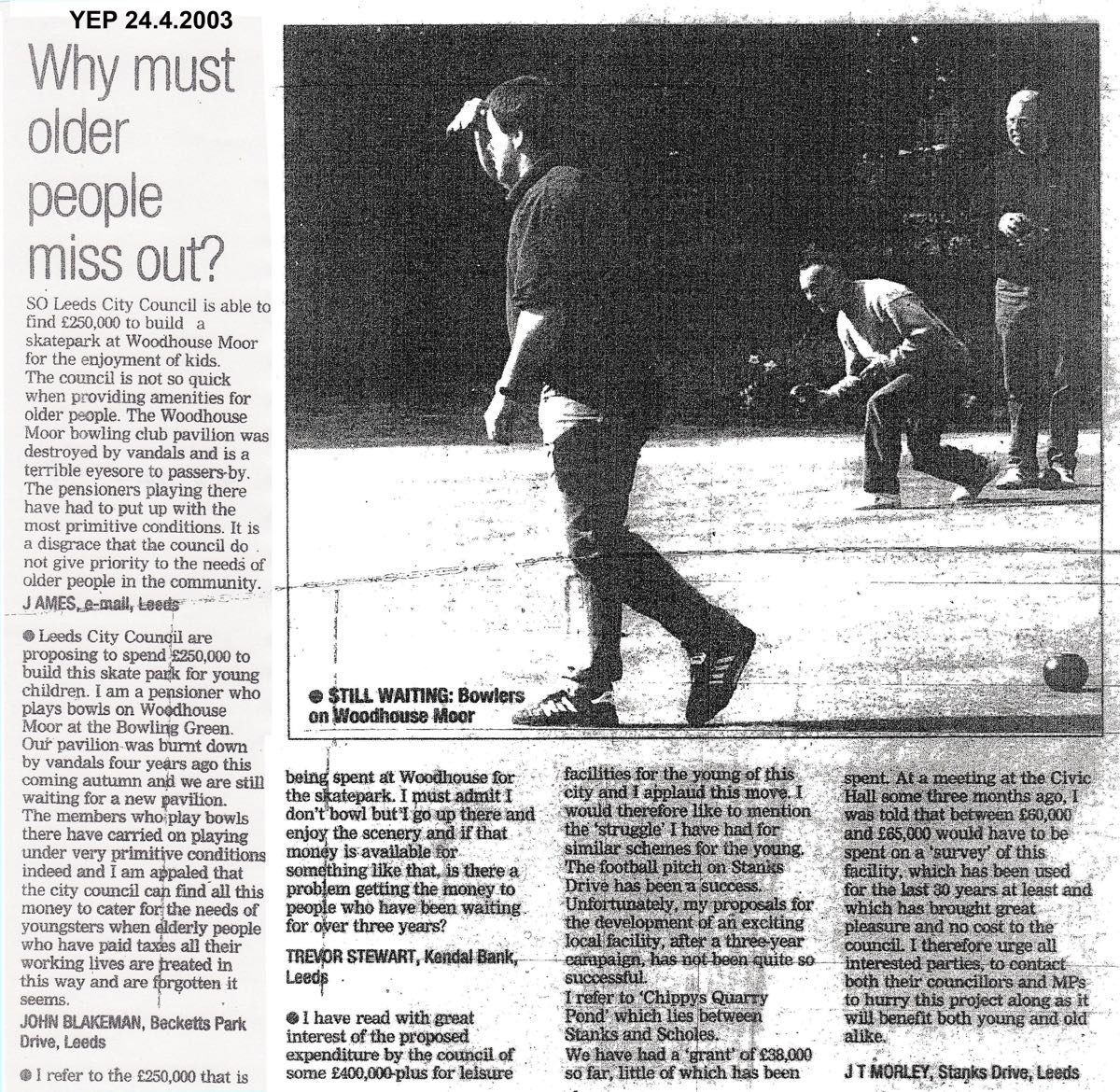
From James by email:
“So Leeds City Council is able to find £250,000 to build a skatepark at Woodhouse Moor for the enjoyment of kids. The council is not so quick when providing amenities for older people. The Woodhouse Moor bowling club pavilion was destroyed by vandals and is a terrible eyesore to passers-by. The pensioners playing there have had to put up with the most primitive conditions. It is a disgrace that the council do not give priority to the needs of older people in the community.”
From John Blakeman of Beckett Park Drive:
“Leeds City Council are proposing to spend £250,000 to build this skatepark for young children. I am a pensioner who plays bowls on Woodhouse Moor at the Bowling Green. Our pavilion was burnt down by vandals four years ago this coming autumn and we are still waiting for a new pavilion. The members who play bowls there have carried on playing under very primitive conditions indeed and I am appalled that the the city council can find all this money to cater for the needs of youngsters when elderly people who have paid taxes all their working lives are treated in this way and forgotten it seems.”
From Trevor Stewart of Kendal Bank:
“I refer to the £250,000 that is being spent at Woodhouse for the skatepark. I must admit I don’t bowl but I go up there and enjoy the scenery and if that money is available for something like that, is there a problem getting the money to people who have been waiting for over three years?”
In a letter published in the YEP on the 10th May 2003 entitled “Bowling club deserves new pavilion,” Craig Hebberd, Secretary of Woodhouse Moor Bowling Club wrote:
“I would like to add my voice to the need for better facilities on Woodhouse Moor, especially for the bowling club.
The club has been waiting nearly four years for a new pavilion only to be repeatedly told that there is no money available. It was to my disgust that I read in the YEP that the skate park was getting a 250,000 face-lift. Mr Hutchinson-Dean’s assumption (Letters April 29) that the bowls club is full of OAP’s is an ill-informed and misguided comment. I am in my early 20s, as are the majority of the club’s members, with only a minority classed as being ‘senior citizens’. I feel that the skate park should be re-vamped as it is showing signs of dilapidation; but, the bowls club only needs 15,000 to build a new pavilion, so why not solve two problems at once?”
THE SKATEPARK AND ANTI-SOCIAL BEHAVIOUR
Woodhouse Moor is classed as a “community park” as opposed to a “city park” which means it’s intended for the use of just the local community rather than everyone in the city. Presumably this is because of its relatively small size.
Despite this, in 2003, the council spent £240,000 building a concrete skatepark on the site of six tennis courts near Hyde Park Corner, which according to a BBC article published in 2003 was intended to attract skateboarders from the city centre (Millennium Square). This Yorkshire Evening Post article from 2002 shows that skateboarders who had been using the newly opened Millennium Square were a thorn in the council’s side. And it was rumoured that Civic Architect John Thorp wasn’t at all happy that skateboarders were using Millennium Square, which he’d designed. It’s because the skatepark on the Moor was intended to attract skateboarders from Millennium Square that the council was willing to spend so much money on it.
The skatepark attracts skateboarders from the rest of Leeds. Parents from elsewhere in the city often drop their teenage sons off at the skatepark and pick them up hours later. Skateboarding on Woodhouse Moor is an almost exclusively male pursuit. The skatepark is permanently covered in graffiti, smells of urine and users leave their litter behind instead of taking it away. The noise from the skatepark can be heard across nearly a quarter of the park.
In July 2009, a BMX biker who used to use the skatepark died and an article in the Yorkshire Evening Post invited bikers to attend a memorial event at the skatepark. A settee was burnt at this event so the bikers could jump over it on their bikes.
The bikers had such a good time, that they decided to do it every year. By 2012, the bonfire had become enormous, as you can see in this photo, this photo and this photo.
This blog post has photos and videos showing the bikers jumping over the enormous bonfire.
This video shows clips of a train journey, presumably the one that brought the bikers to Leeds. It also shows the bonfire being built.
This video shows students travelling by train from Peterborough and meeting up with other students in Leeds to travel to the 2013 event. It also shows the enormous bonfire and a biker with a French accident. I suppose he’d be arrested if he tried jumping over a bonfire in the Garden of Luxembourg!
This post from RideUK says its photo of a rider jumping over the blaze was the magazine’s best ‘cover’ ever.
And the skateboarders want the skatepark to be floodlit as you’ll see from this post which claims the skatepark is useless in the Autumn and Winter without floodlighting.