Building harmonious relationships on the Moor.

Building harmonious relationships on the Moor.

victoria-staute

I would like to stress that I am writing this guest post in an individual capacity and my views in no way necessarily represent those of any organisation I am a member of; they are purely individual views.

The debate over the council’s proposals to build a designated barbecue area on Woodhouse Moor has been contentious to say the least. On the one side local residents have raised concerns about the damage the construction of this area will do to the Moor and on the other side you have the council and people like myself who have argued that the proposals are the best practicable way to manage barbecues on the Moor and, of course, the people who want to use the Moor to have barbecues on. It is worth saying that the debate has exposed a tension at the heart of our community between permanent residents who feel ignored and temporary residents, ie, students who live here in a fair concentration. It is my view that establishing harmony between the two groups is one of the key challenges facing this community.

Turning to the proposals in detail; it has often been pointed out to me that there are by-laws in place which prohibit barbecues on the Moor and that preventing them is simply a matter of enforcing the existing by-laws. Councillor Martin Hamilton, speaking to the Yorkshire Evening Post on May 20th, raises a valid point when he questions whether creating a situation where the police will have to be involved is the most productive use of their time. One of the concerns has to be that so much time and effort would be spent enforcing the barbecue ban that serious anti-social behaviour would slip under the radar.

Also, since there has been a serious increase in demand for barbecues on the Moor there has to be questions asked over where the people who would have had barbecues on the Moor would then go. Shifting the problem around the place is not a solution and we do have to address the fact that some people clearly do want this; so, a question I do have to put to opponents is how would you address this? Concerns about the environmental impact of disposable barbecues are points well made but it is my view that a properly designated area could and should go hand-in-hand with providing raw materials and guidance for people to actually construct a rudimentary (but still effective) eco-friendly barbecue which can be effectively done with a few bricks; a grill you can find in any kitchen and the right charcoal. Here perhaps the proposals need to show greater imagination than just whacking concrete slabs down.

The same article points out that Woodhouse Moor has been used for “everything from hare-coursing and horse racing to a stage for political rallies and public demonstrations”. So, this isn’t exactly a new controversy but a re-casting of the tensions that exist over Woodhouse Moor itself and doubtless other green spaces across the country. Bill McKinnon speaking in the piece flags up the recent residents meeting which was attended by “over 100 residents, people who consider the Moor part of their home”. However, the Moor is not, properly speaking part of anybodies home; it is a public space which we all share, it is too their credit that people feel this strongly about something that is an important part of this community but nonetheless the facts remain as above.

Mr McKinnion is right when he says that if a designated area was created there would still be a question of enforcement but quite simply I would say restriction is always easier to enforce than prohibition. He is also right to raise the issue of ensuring the underground drainage is not damaged and let my emphasise that I am not here to defend the consultation not reaching everybody or any other problems that have been had. Looping-the-loop somewhat to the point I started off by making this does point to the need for new mechanisms to establish working relations between the residents who live around the Moor and the people who visit the Moor and want to enjoy it in a responsible way.

At the moment where the different interested groups come together tends to be the Area Committee; however, it is my view that this organisation has too broad a remit to deal effectively with this very specific issue which needs to see the local residents; people who work to preserve the Moor, and yes, representatives of the student community working together along with our local elected representatives. Therefore, I think the Area Committee should devolve this issue down to a sub-committee which reports to it and addresses issues like this directly.

CRIMEAN WAR CANNON

CRIMEAN WAR CANNON

Crimean War Cannon

On the 6th September 2008, there was an interesting article in the Yorkshire Evening Post about two captured Russian cannon taken from a Russian ship at Sebastopol during the Crimean War. These were subsequently placed on Woodhouse Moor with great ceremony in 1857, and remained there until they were carted away in 1940 purportedly to be melted down as part of the war effort. The Moor may have lost the cannon, but it still has a connection to the Crimean War thanks to nearby Raglan Road and Cathcart Street, both named after Crimean War commanders.

If the article’s print is too small for you to read, please click on your browser’s “View” button and use the “Zoom” facility.

MORE LETTERS TO THE YEP

MORE LETTERS TO THE YEP

Lady posting letter

Once again, local residents have been furiously setting pen to paper to express their opinion on the proposal to establish barbeque areas on Woodhouse Moor. And no wonder, given the way so many have been disenfranchised by councillors who’ve gone out of their way to ensure that people not on the electoral register have a say in whether or not barbeques are legalised.

On Tuesday, there were letters from Bernard Atha, Jonathan Eyre, Albert Slingsby, and Christopher Todd. On Wednesday, there were letters from Colin and Marian Smith, Janet Sherwin, and Kathleen Mason. And on Friday, there were letters from Darrell Goodliffe, Louise Coombes, and Carol Millard.

All of the letters were against the proposal except the one from Lib Dem activist Darrell Goodliffe, who also had a letter published last Thursday.

(photo courtesy of Caverguy)

LEGALISING A NUISANCE

LEGALISING A NUISANCE

The smoke pollution caused by just one barbeque

In his recent letter to the Yorkshire Evening Post (Readers’ Letters 15.5.09), Darrell Goodliffe claims that the existing byelaws restrict the “legitimate freedom” of people without gardens to have barbeques on Woodhouse Moor. For this reason, he supports the council’s proposal to allow barbeques on the Moor. Mr Goodliffe says that the damage caused by barbeques will be limited by restricting them to designated areas. But to those who point out that drifting smoke would interfere with other park users’ right to breathe unpolluted air, he has no answer. Instead, he suggests that if drifting smoke is a problem, then the opponents of the barbeque proposal should also be calling for barbeques in private gardens to be banned. In effect, he’s saying that having to breathe barbeque smoke in a park is no different to having to breathe it in your garden. But to compare barbeques in public parks with barbeques in private gardens is not comparing like with like. If the smoke from my neighbour’s barbeque is causing a nuisance, I can ask him to put it out. If he ignores my request, I have the remedy at law of taking out an injunction to prevent him having barbeques in the future. But if barbeques are legalised on Woodhouse Moor, if I asked someone having a barbeque there to extinguish it, they would be within their rights to tell me to go to one of the other Leeds parks where barbeques are still banned. And for the same reason, I would have no remedy at law.

Recently, on the Yorkshire Evening Post website, a lady from Ottawa commented that she lives close by to what used to be a lovely park. Then her local authority legalised barbeques. As a result, the only people who now visit the park, are those who go there to have a barbeque. The residents of Hyde Park, Woodhouse and Headingley are fighting this proposal so that everyone can continue to enjoy Woodhouse Moor, not just a selfish minority.

The above photograph was taken on the 12th May 2009 and shows the smoke pollution from just one barbeque. Multiply this by 40 to get an idea of the level of pollution that Leeds City Council considers acceptable on a park which when it was purchased in 1857 was known as “the lungs of Leeds”.

BEHIND THE MASK

BEHIND THE MASK

Mask

It’s customary when writing to a newspaper, to supply an address. Many editors will refuse to publish your letter if you don’t. It’s about establishing your credentials as a real person, rather like the purpose of the electoral register. So it was highly significant that in his recent letter to the YEP, Darrell Goodliffe signed off as “Local Resident” rather than supplying an address (Readers’ Letters 7.5.09). Clearly for Mr Goodliffe, establishing in readers’ minds that here was a local resident who actually supports the barbeque proposal, was far more important than minor details like where he actually lives.

What’s not customary when writing to a newspaper is to state your political allegiance, unless of course you’re an active party member writing about an issue your party is deeply involved with. Under those circumstances, to deny your readers the benefit of that knowledge, might seem to some like a deception. I can understand though why someone would be tempted to do it. By stating your political allegiance, you run the risk that people might say “Well, he would say that, wouldn’t he”. Which is precisely what people have been saying since learning that Darrel Goodliffe is a Lib Dem activist.

(photo courtesy of Thomas Hawk)

LETTERS IN THIS WEEK’S YEP

LETTERS IN THIS WEEK’S YEP

Letters

There were lots of letters in this week’s Yorkshire Evening Post on the subject of the barbeque proposal. The first was published on Tuesday and was from Phil Graham asking why he should pay council tax when the council won’t uphold the byelaws. Of course it’s a rhetorical question because Phil knows very well that if he didn’t pay council tax, they’d come and lock him up. If the people who have illegal barbeques knew that the same fate awaited them, there wouldn’t be a barbeque problem. The second letter appeared on Wednesday and was from Councillor Martin Hamilton who says that if the police had to deal with anti-social behaviour on the Moor, they wouldn’t be able to deal with more serious crime elsewhere. Councillor Hamilton, a former chair of INWAC, fails to mention that INWAC can make council funds available to the police to pay for additional policing. He also fails to mention that the assignment of park wardens to the park would improve park security without affecting policing elsewhere in the area and that last July, a deputation of local residents asked the council for two park wardens to be assigned to Woodhouse Moor, and were refused. The next letter also appeared on Wednesday and was from L E Slack who feels that the barbeques are inappropriate in parks, and that the consultation process is unethical. On Thursday, there were letters from Darrell Goodliffe and Tony Green. Mr Goodliffe says that opponents of the barbeque proposal “suffer from a basic refusal to deal with reality” and wear “blinkers”. Tony Green in his letter reports on the recent public meeting and the resounding “No” it gave to the barbeque proposal. On Friday, Cherril Cliff who lives in Armley, but works in Woodhouse, voiced her opposition to the proposal. Also in Friday’s paper was a letter from Howard and Christine Eaglestone asking how likely it is that people will keep to the proposed barbeque areas. Then in today’ paper, in a relatively short letter, former Headingley councillor David Morton makes a number of highly relevant points about the proposal itself, the consultation, the ASB that’s allowed on the park, and the neglect.

(photo courtesy of Francesca Tronchin)

BERNARD ATHA’S VIEW : THE MOOR IS UNDER SUSTAINED ATTACK

BERNARD ATHA’S VIEW : THE MOOR IS UNDER SUSTAINED ATTACK

Bernard Atha

On Friday the 1st May, Councillor Bernard Atha issued the following statement :

“The Moor is under sustained attack now. Every day sees further damage.
I am opposed totally to the proposals for the barbecue slabs. They would not be allowed in Roundhay or Horsforth or Guiseley. Why Woodhouse?
I have asked that this proposal be submitted for planning application. I have not yet had a response after more than a week.
I have asked that big notices be put up saying barbecues are a breach of the bye laws and offenders will be prosecuted.
I have asked that local funds available to the Councillors are used to pay for extra police supervision and enforcement.
I have pointed out that the Lib Dems could stop this scheme now. Labour has 42 votes in the Council and the nine Lib Dems have nine in Inner North West Leeds making sure that any proposal to stop the scheme and save the Moor could be carried.
I have objected to the views expressed by the local Lib Dem Councillor James Matthews that as we cannot police the park we had better control it by this plan.
I object to the other Lib Dems who say they await the result of the consultation which, as many have written in to say, is a fraud as so many local residents have not received the consultation document which in itself was designed to produce the answer required.
I object to the statement made by the Lib Dems who say that the scheme is Cllr John Procter’s idea. He is a Tory. The idea has not come from John Procter I am sure, and in any case the Lib Dems and the Conservatives have formed a coalition and the Lib Dems are the biggest Party in that coalition.

We must defeat this stupid and damaging proposal and collectively make sure the Moor is protected and supervised properly.
The Lib Dem coalition has mounted a series of attacks on the Moor : making part of it a car park, turning over a large area to accommodate University pitches, a drinking den for easier supervision of the alcoholics displaced from elsewhere and hacking away a substantial strip of it to form a bus lane to ease traffic on what is the widest stretch of road on this extremely busy route out of Leeds. These have all been schemes produced by the coalition in which the Lib Dems are the largest Party.”

(published courtesy of Bernard Atha)

Residents give a resounding “No” to concrete slabs on Moor

Residents give a resounding “No” to concrete slabs on Moor

Heated debate over barbecue proposals

 Yorkshire Evening Post, 29 April 2009
 Some people's idea of fun

Leeds’s Woodhouse Moor is in danger of destruction from both Council policy and barbecue parties, a public meeting was told. Richard Hellawell, who lives in the Kendals, said by-laws banning barbecues on the moor had to be enforced.

Speaking at Woodhouse Community Centre Mr Hellawell said: “Woodhouse Moor is a beautiful open space, it is a wonderful lung. “It is in danger of being destroyed by those who have barbecues, or by the councillors who will put concrete monstrosities on there. The existing by-laws ban barbecues, the police do not enforce them so it is up to the Council to do it.”

This story is reproduced with kind permission of the Editor. 

 See also the YEP’s editorial of the same day.

CONCRETE BLOCK SCHEME POSES THREAT TO THE MOOR’S VICTORIAN DRAINAGE SYSTEM – ANOTHER REASON WHY THE COUNCIL SHOULD BE APPLYING FOR PLANNING PERMISSION

CONCRETE BLOCK SCHEME POSES THREAT TO THE MOOR’S VICTORIAN DRAINAGE SYSTEM – ANOTHER REASON WHY THE COUNCIL SHOULD BE APPLYING FOR PLANNING PERMISSION

Clay Drainage Pipe
One of my neighbours rang me this morning to tell me she’s concerned that the council’s scheme to sink 60cm x 90cm x 60cm concrete blocks 60cm into the ground will interfere with the Moor’s drainage system, installed in Victorian times. She told me that there are springs beneath the Moor. These springs used to cause the Moor to be really marshy. Streams would form from the water that gathered on the Moor and these streams would run across what is now Hyde Park Road and Moorland Road and down the hillsides. The streets known as the Rillbanks at the bottom of Woodsley Road got their name from the fact that “rill” is another word for stream. Sometime after the Town Council bought the Moor in 1857, they drained it. This probably means that they installed beneath the surface, a system of perforated clay drainage pipes. The lady who rang me told me that in the Autumn, if you go onto the Moor and listen carefully, you can hear water running beneath the grass. This must be the sound the water makes as it passes through the drainage pipes. If Leeds City Council goes ahead with its scheme to sink 40 concrete blocks 60cm into the ground, the chances are that they’ll destroy this Victorian drainage system. This would very likely turn the Moor back into a marsh. And then wouldn’t that be a good excuse for the council to send in bulldozers and workmen to level and drain the Moor so that the part not used for barbeque areas, could be turned into playing fields or whatever else the council wants.

(photo courtesy of mahalie)

LOCAL RESIDENTS CALL FOR ENFORCEMENT OF THE EXISTING BYELAWS ON BARBEQUES

LOCAL RESIDENTS CALL FOR ENFORCEMENT OF THE EXISTING BYELAWS ON BARBEQUES

John Egan

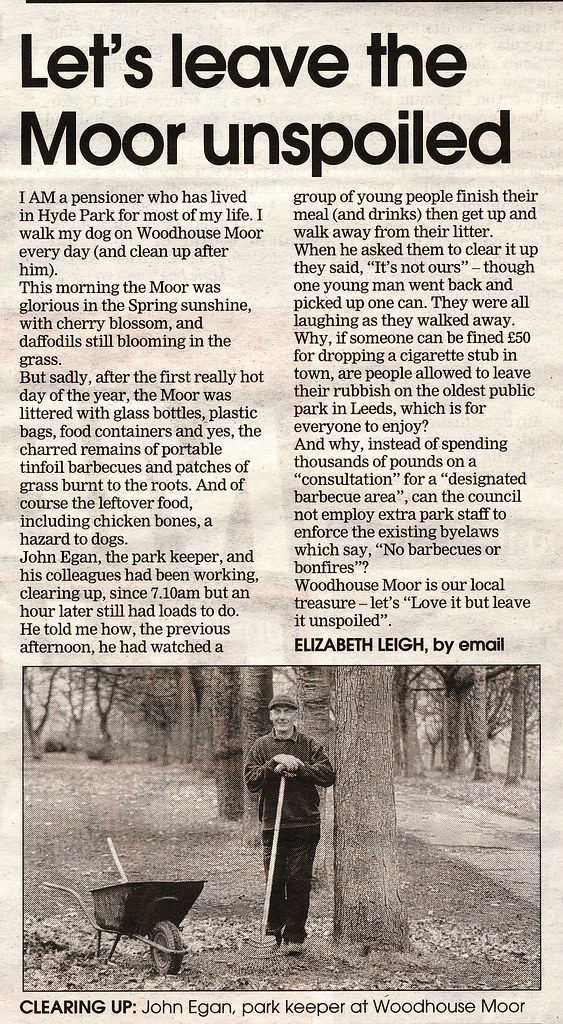
Once again the council’s scheme for barbeque areas has been in the news with two letters about it published in the Yorkshire Evening Post. The first letter was published on Wednesday and was from local resident Kathleen Mason who gives several very good reasons why the scheme is a bad idea, and the consultation exercise, undemocratic. At the end of her letter, Kathleen says she doesn’t want the smell nor the sight of this activity, nor any more money spending on the proposed scheme. I know just what Kathleen means. When I cut across the Moor on my way home this evening, I had to walk through barbeque smoke for the entire length of the path that runs alongside the bowling greens towards the Wellington statue. It was horrible.

The second letter was published on Thursday and was from pensioner Elizabeth Leigh. Elizabeth’s heart goes out to the gardener John Egan and his colleagues, who every morning after it’s been warm and sunny, have to begin their day by spending hours cleaning up the mess. Elizabeth asks why the council doesn’t employ park wardens to enforce the existing byelaws, instead of spending thousands on the current consultation exercise.