Cinder Moor

LOW MOOR AS A CRICKET AND FOOTBALL PITCH
Cinder Moor is a recent nickname for the part of Woodhouse Moor formerly known as Low Moor. The area was levelled in 1885 in order to create a cricket pitch. The first mention of the proposal was in an article published in the Leeds Times in February 1884. It stated:
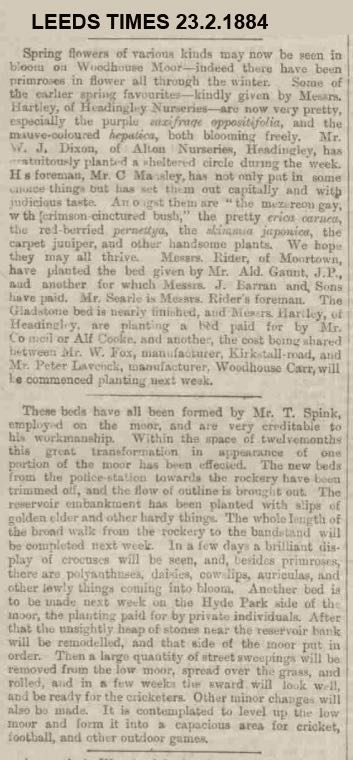
“It is contemplated to level up the low moor and form it into a capacious area for cricket, football, and other outdoor games.”
The formal proposal was announced in an article published in the Leeds Times in July 1884, of which this is an extract:
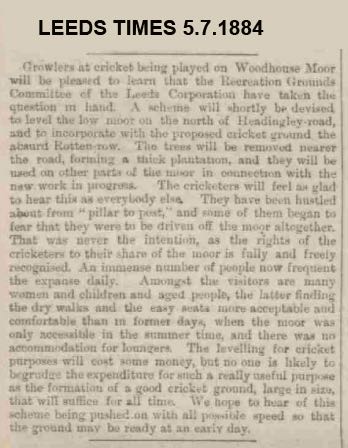
“Growlers at cricket being played on Woodhouse Moor will be pleased to learn that the Recreation Grounds Committee of the Leeds Corporation have taken the question in hand. A scheme will shortly be devised to level the low moor on the north of Headingley-road, and to incorporate with the proposed cricket ground the absurd Rotten Row. The trees will be removed nearer the road, forming a thick plantation, and they will be used on other parts of the moor in connection with the new work in progress. The cricketers will be as glad to hear this as everybody else.”
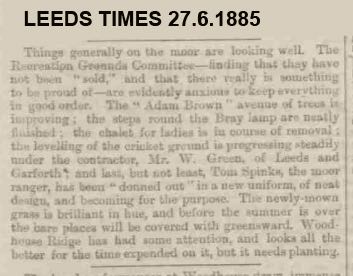
In February 1885, the council voted £400 to cover the cost of levelling the ground. The contractor chosen was a Mr W Green of Leeds and Garforth.
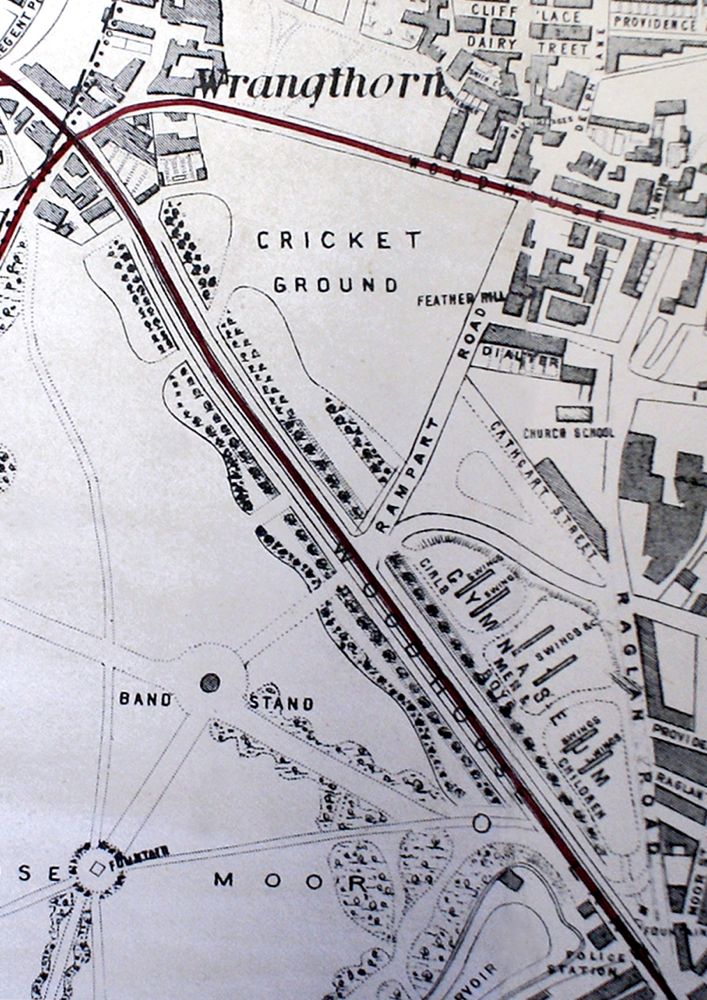
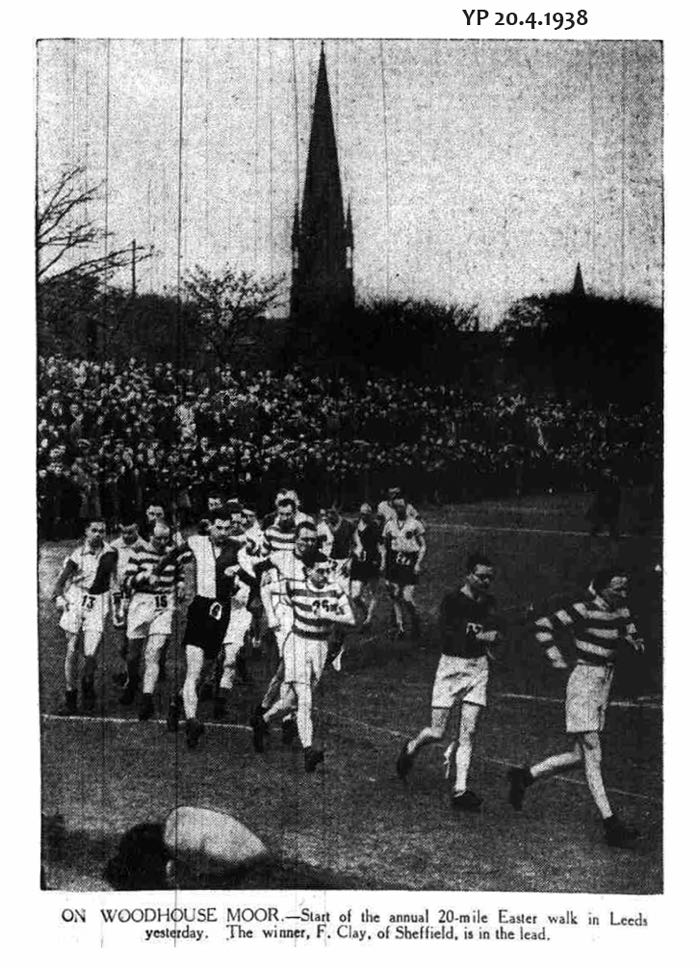
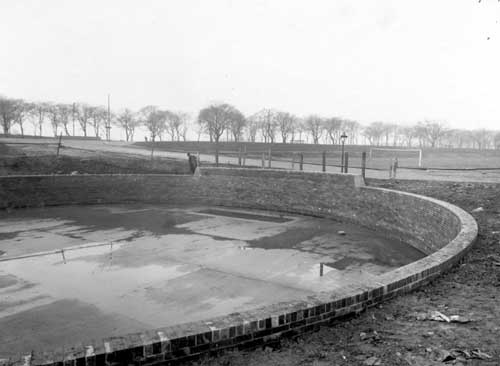
This map published around 1892 shows the area as a cricket ground. Later maps from the 20th century show the area as both a cricket ground and a football ground. This photo from April 1938 shows a race taking place on Low Moor with the grass marked out as a football pitch. This photo from March 1942 shows a newly constructed water tank on the lower half of Monument Moor, and a goalpost in the background on Low Moor.
An article published in the Yorkshire Post in February 1950 states that the Territorial Army had asked permission to hold a display on Low Moor and Hunslet Moor. The article records:
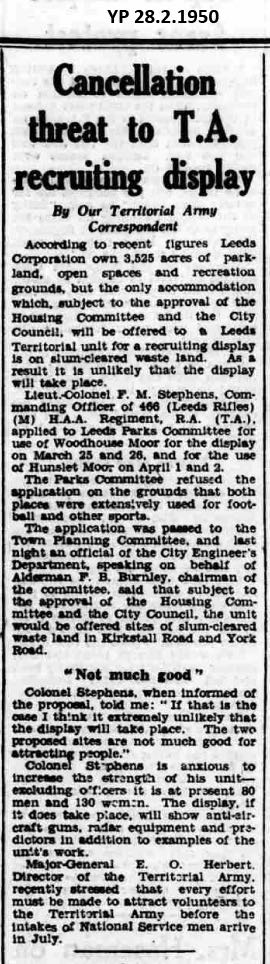
“The Parks Committee refused the application on the grounds that both places were extensively used for football and other sports.”
THE LORD MAYOR’S HELICOPTER RIDE FROM LOW MOOR
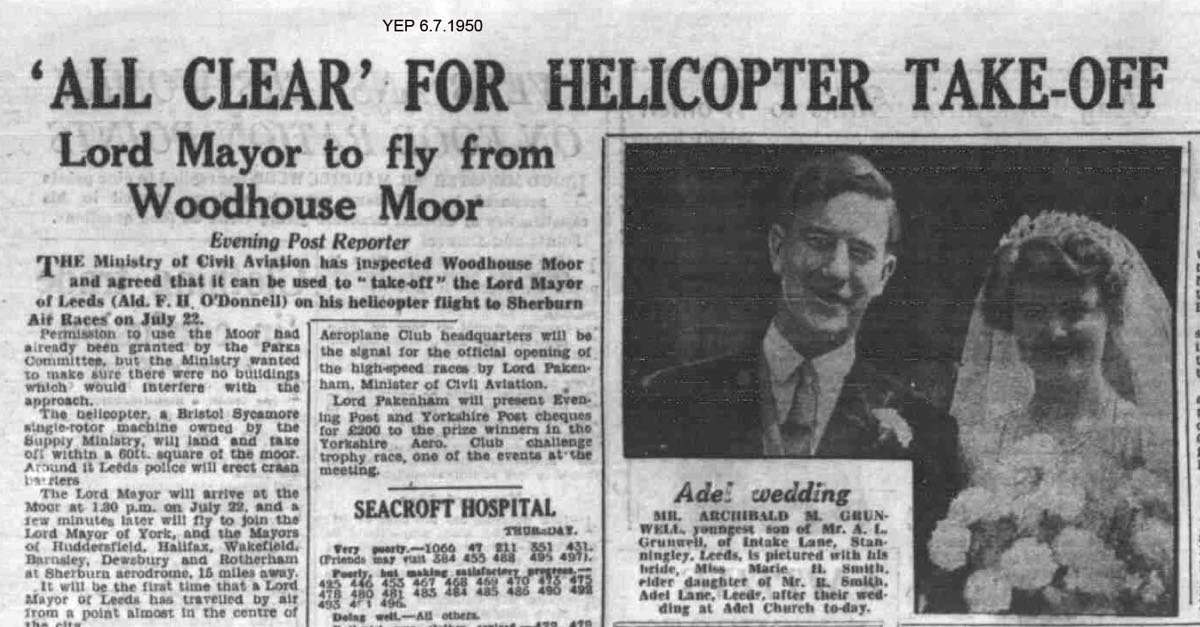
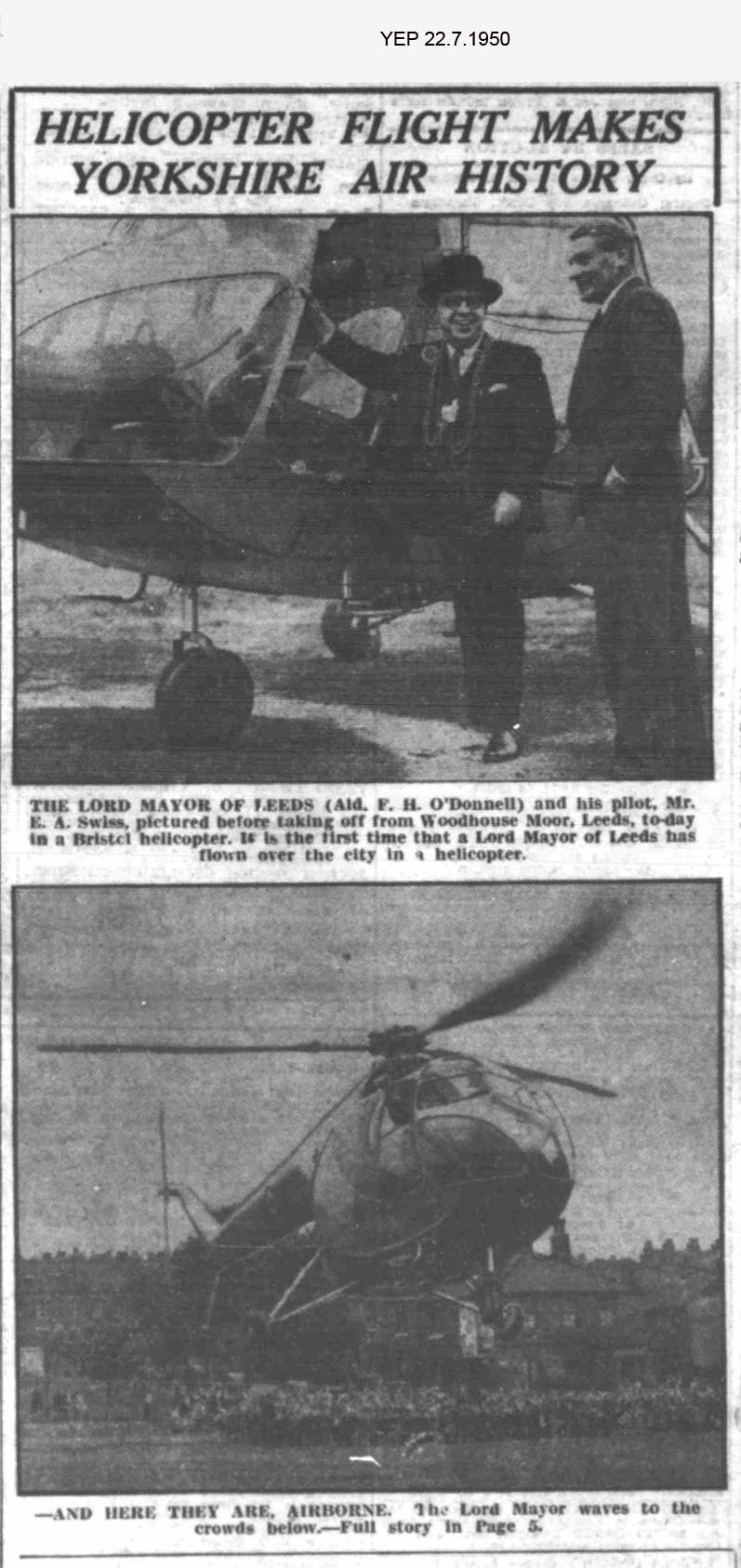
In June 1950, it was announced in the Yorkshire Post that on the 22nd July, the Lord Mayor, Alderman F O’Donnell was to fly from Low Moor to Sherburn for the opening of an air pageant. The article states that permission for the take-off from Low Moor had been granted by the Parks Department. It was subsequently reported that the flight would be made by a Bristol Sycamore Mark 1 single rotor helicopter. The Yorkshire Evening Post published photos showing the Lord Mayor just before, and just after take off from Low Moor. The paper reported that just before boarding the helicopter on Low Moor, the Lord Mayor said:
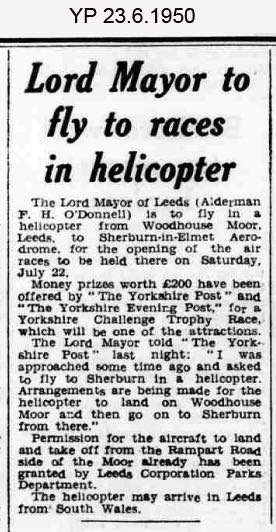
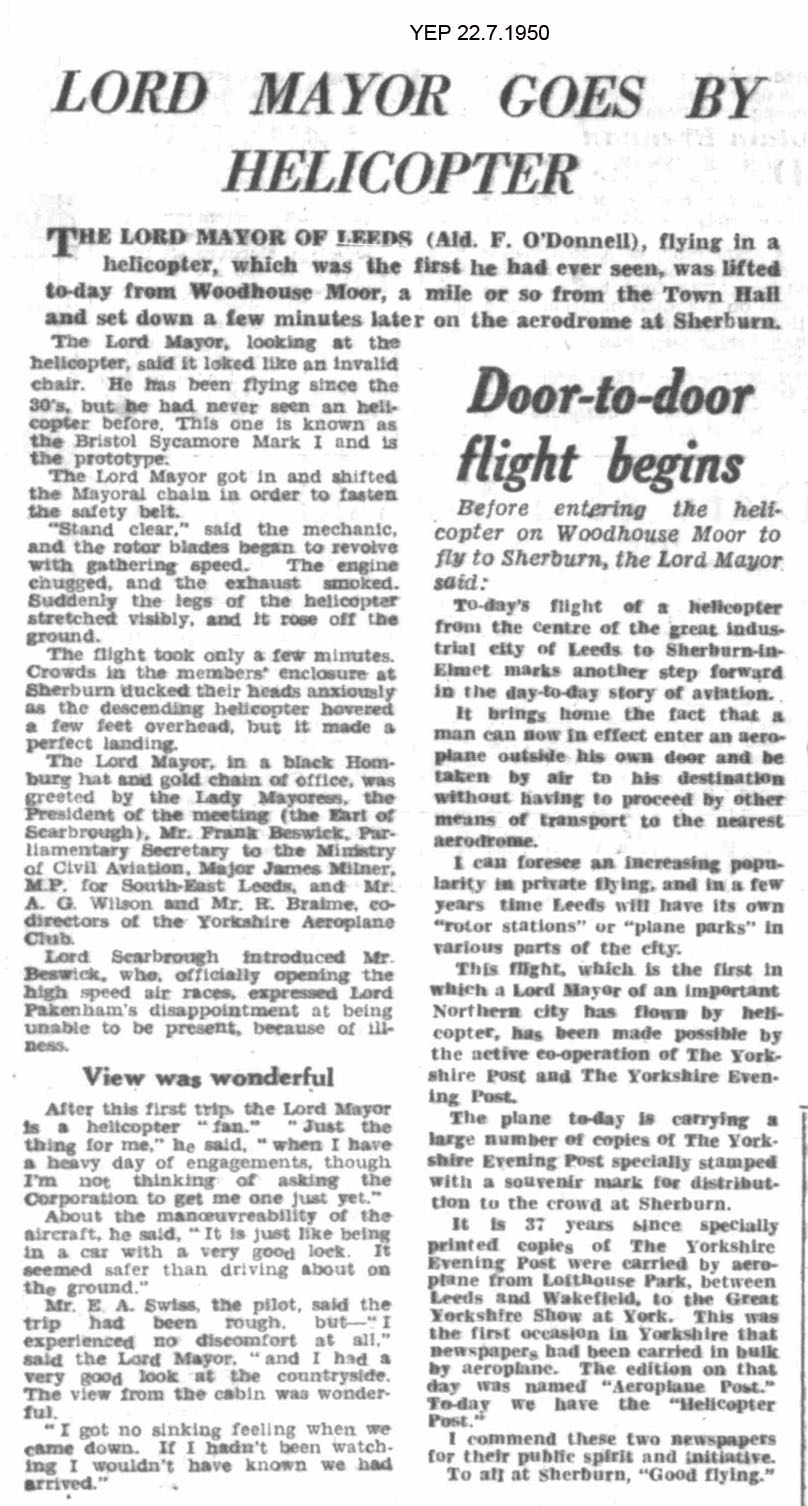
“Today’s flight of a helicopter from the centre of the great industrial city of Leeds to Sherburn-in-Elmet marks another step forward in the day to day story of aviation.
It brings home the fact that now a man can in effect enter an aeroplane outside his own door and be taken by air to his destination without having to proceed by other means of transport to the nearest aerodrome.
I can see an increasing popularity in private flying, and in a few years time, Leeds will have its own ‘rotor-stations’ or ‘plane parks’ in various parts of the city.”
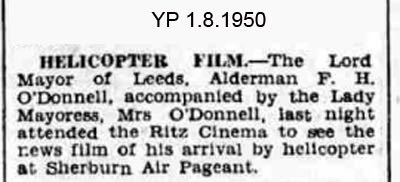
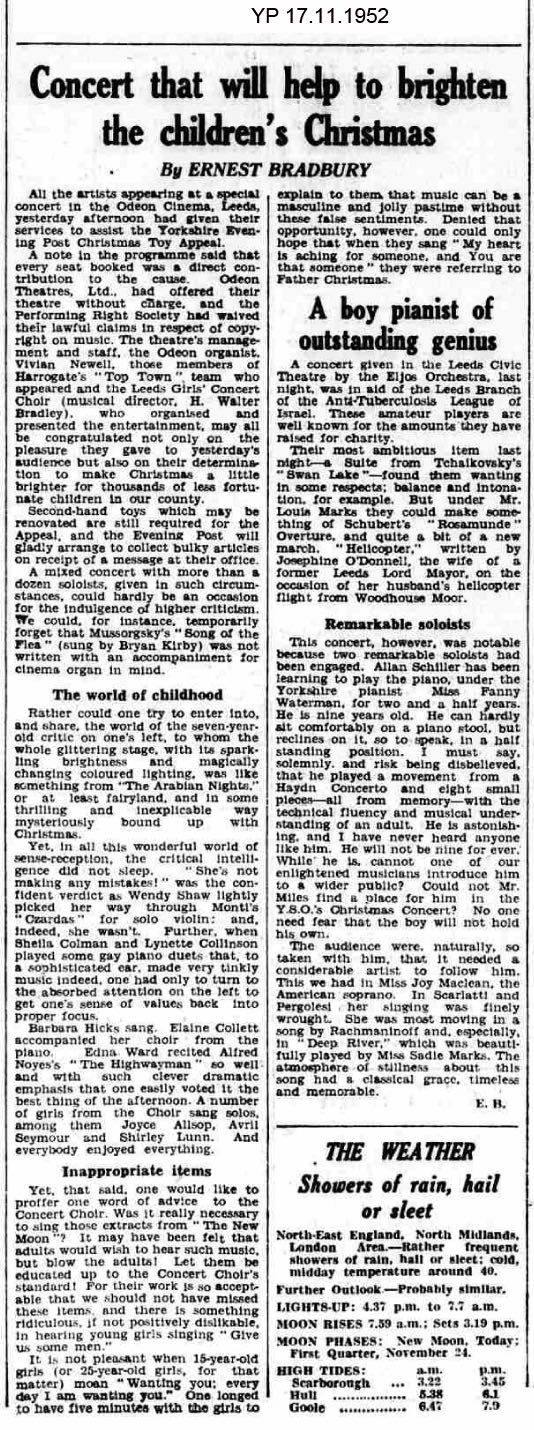
An article published in the Yorkshire Post in August 1950 reveals that the mayor and his wife had attended the Ritz cinema to watch a news film showing him arriving at Sherburn by helicopter. On the 17th November 1952, the Yorkshire Post’s music correspondent Ernest Bradbury reported that at a concert given the previous evening at Leeds Civic Theatre, the Eljos Orchestra had played a new march called ‘Helicopter’ written by Josephine O’Donnell, the wife of the former Lord Mayor, ‘on the occasion of her husband’s helicopter flight from Woodhouse Moor.’
LOW MOOR IS APPROPRIATED TO BECOME A HELIPORT
In April 1951, the Yorkshire Post announced the publication of the council’s draft Development Plan produced by Mr D Currie, the city’s chief engineer and planning officer. Amongst other things, it stated:
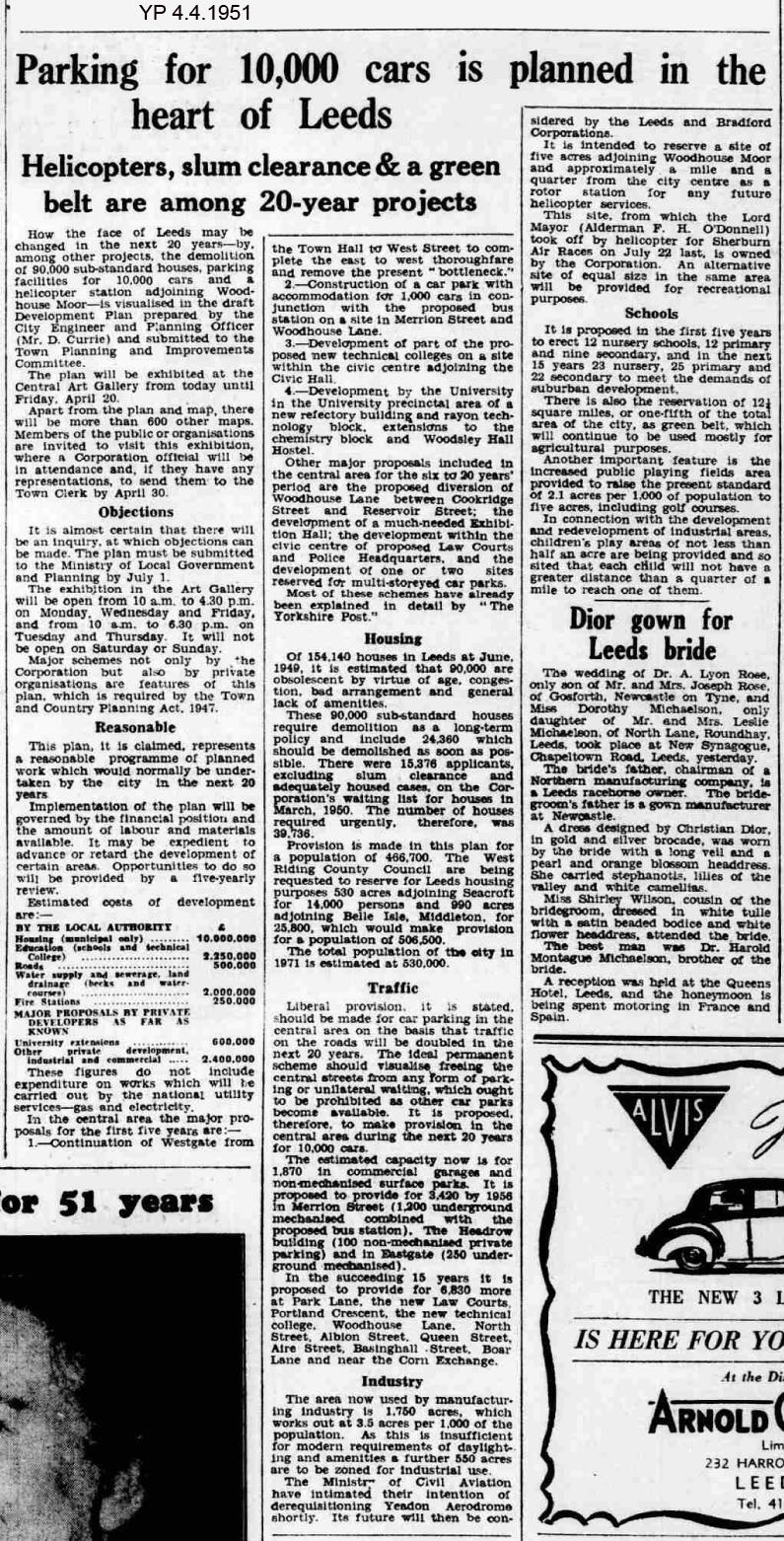
“It is intended to reserve a site of five acres adjoining Woodhouse Moor and approximately a mile and a half from the city centre as a rotor station for any future helicopter services.
This site, from which the Lord Mayor (Alderman F H O’Donnell) took off by helicopter for Sherburn Air Races on July 22 last, is owned by the Corporation. An alternative site of equal size in the same area will be provided for recreational purposes.”
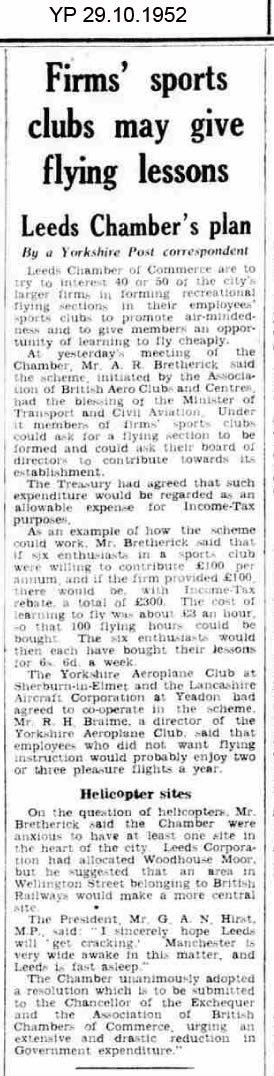
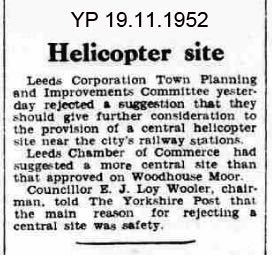
In October 1952, the Yorkshire Post reported that the Chamber of Commerce would have preferred a site on land owned by British Rail on Wellington Street, to the site at Woodhouse Moor, as the Wellington Street site was more central. The following month, the paper reported that the council had rejected the Chamber’s suggestion on the grounds of safety. In January 1953, the Yorkshire Evening Post reported that at a meeting of the Chamber, its president had stated the reason that the council had given him for their refusal of a Wellington Street site:
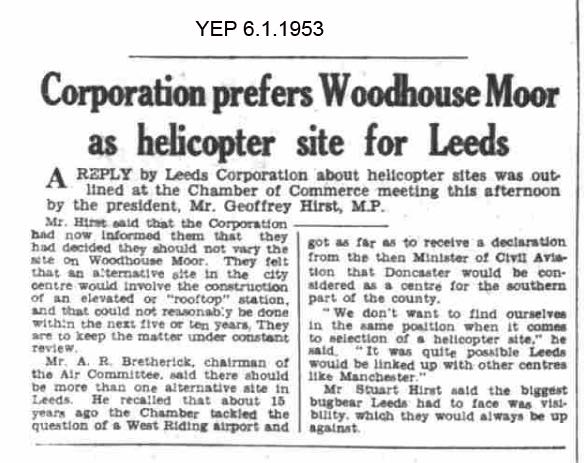
“They felt that an alternative site in the city centre would involve the construction of an elevated or ‘rooftop’ station, and that could not reasonably be done within the next five or ten years. They are to keep the matter under constant review.”
In May 1953, the Yorkshire Evening Post published a letter from a local resident questioning the propriety of placing a heliport on Woodhouse Moor. In response, the paper printed a reply given by the council:
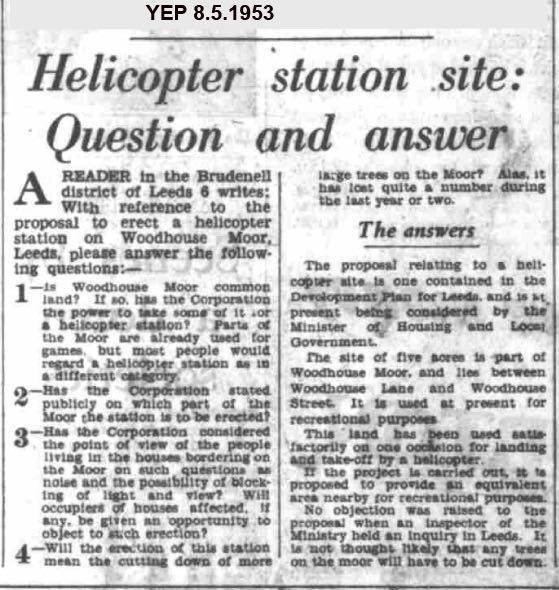
“The proposal relating to a helicopter site is one contained in the Development Plan for Leeds, and is at present being considered by the Minister of Housing and Local Government.
The site of five acres is part of Woodhouse Moor, and lies between Woodhouse Lane and Woodhouse Street. It is used at present for recreational purposes.
This land has been used satisfactorily on one occasion for landing and take-off by a helicopter.
If the project is carried out, it is proposed to provide an equivalent area nearby for recreational purposes.
No objection was raised to the proposal when an inspector of the Ministry held an inquiry in Leeds. It is not thought likely that any trees on the moor will have to be cut down.”
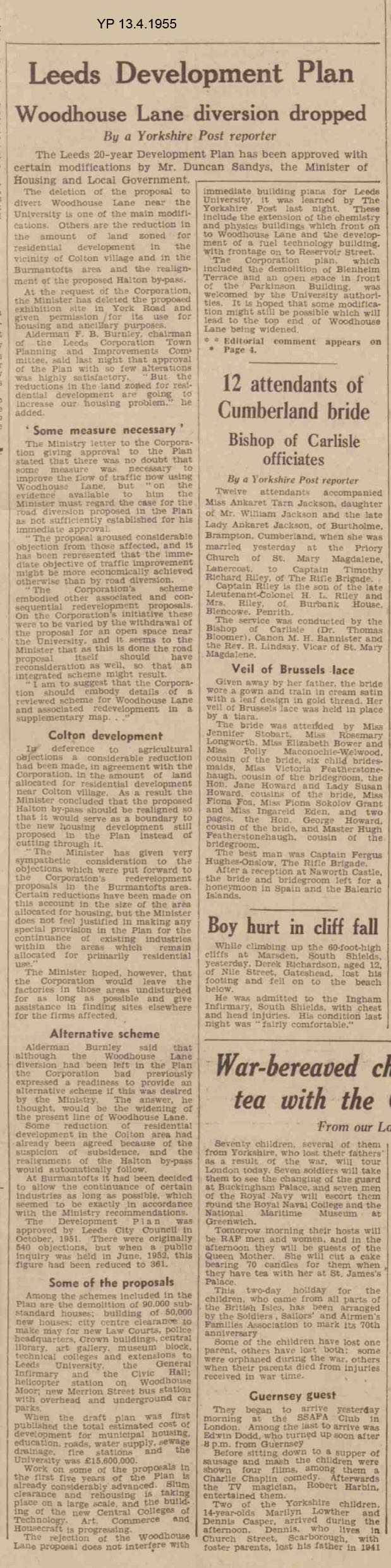
In April 1955, the Yorkshire Post reported that the government had approved Leeds’ 20 year Development Plan. The Plan had been approved by the council in October 1951 and included a helicopter station on Low Moor.
EPILOGUE
The area now known as Cinder Moor was laid out as a cricket ground in 1885. It was also used as a football ground. In 1950 the council refused to allow the land to be used for a Territorial Army display on the ground that it was needed for football and other recreation But in 1955, the land was designated as a heliport as part of the council’s 20 year Development Plan. On the Ordnance Survey map published in 1955, Cinder Moor was still shown as a cricket and football ground. And a long term resident of Woodhouse has informed me that it was still being used as a sports field well into the 1960s. He used to go there on a Sunday morning with his father to watch his uncle playing football for Quarry Mount Working Men’s Club. These were organised matches played on pitches marked out by the council on the cinders. Cinder Moor was also used in 1960 as a playing field for Quarry Mount School. Since that time, it has never been used for sport. However, the council’s “Current Planning Policy Map” published in February 1973 shows all of Woodhouse Moor, including Cinder Moor, as “Public Open Space.” The current UDP shows it all as N1 greenspace. The Site Allocation Publications Draft shows Cinder Moor as Amenity Greenspace. The Site Allocations Publication Draft also shows that Hyde Park and Woodhouse ward has “Outdoor Sports” provision of just 0.16 hectares per 1,000 population, even though the council’s requirement is 1.20 hectares per 1,000 population (see the table on page 14 of the Site Allocations Plan Green Space Background Paper . This is almost one tenth of the requirement. We therefore have to ask the following questions:
Why is Leeds City Council failing to restore Cinder Moor for use as a football pitch for the use of local people?
Why have we lost the vision for Woodhouse Moor that out Victorian forefathers had?
In 2017, Councillor Jonathan Pryor, a Labour councillor representing Headingley ward, made a commitment to restore Cinder Moor as a playing field. But since Councillor Pryor’s elevation to the council’s Executive Board, there has been no further mention of this.
As this recent photo shows, if Cinder Moor was laid out as a cricket pitch and football pitch once more, it would be made good use of by local residents.